
Understanding how visitors interact with your website is fundamental to digital success. A website views tracker enables businesses to monitor traffic patterns, measure engagement, and make informed decisions about content strategy. As privacy regulations evolve across Europe and globally, selecting the right tracking solution has become more complex than simply installing a script. Modern website owners must balance thorough data collection with visitor privacy, regulatory compliance, and technical performance.
What Is a Website Views Tracker
A website views tracker is a software tool that records and analyses visitor interactions on your website. These systems capture data about page views, unique visitors, session duration, traffic sources, and user behaviour patterns. The technology works by embedding tracking code into your website pages, which then communicates with analytics servers to process and store information.
Traditional tracking methods rely on cookies to identify returning visitors and build user profiles. However, things have shifted dramatically since 2018 when the General Data Protection Regulation (GDPR) took effect across the European Union. Modern tracking solutions now employ various methodologies, from cookieless fingerprinting to server-side analytics, each with distinct advantages and compliance considerations.
Core Metrics Every Tracker Monitors
A reliable website views tracker captures several essential data points:
- Page views: Total number of pages loaded by all visitors
- Unique visitors: Individual users visiting your site within a timeframe
- Session duration: Average time visitors spend on your website
- Bounce rate: Percentage of visitors who leave after viewing only one page
- Traffic sources: Where visitors originate (search engines, social media, direct traffic)
- Device and browser information: Technical details about visitor environments
- Geographic location: Country, region, or city of visitors
- Entry and exit pages: Which pages attract visitors and where they leave
These metrics form the foundation of web analytics, providing insights that drive strategic decisions.
Why European Businesses Need Different Tracking Solutions
European website owners face unique challenges when implementing a website views tracker. The regulatory environment demands strict adherence to privacy principles, with potential penalties reaching €20 million or 4% of annual turnover for non-compliance. Beyond financial risk, reputation damage from privacy violations can permanently harm customer relationships.
Data sovereignty has become a serious concern. When analytics data flows to servers outside the European Economic Area, it triggers cross-border data transfer obligations. Following the Schrems II decision in 2020, which invalidated the EU-US Privacy Shield, businesses must carefully evaluate where their analytics provider stores and processes information.
Many legacy analytics platforms require intrusive cookie consent mechanisms that disrupt user experience. These pop-ups reduce conversion rates and create friction in the customer journey. A website views tracker designed with privacy-first principles eliminates this barrier entirely.
The Cookie Consent Dilemma
Approach | User Experience | Compliance Risk | Implementation Effort |
|---|---|---|---|
Traditional cookies with consent | Poor (multiple pop-ups) | Low if done correctly | High |
Cookieless tracking | Excellent (no interruptions) | Very low | Low |
No tracking | Perfect | None | None |
Hybrid approach | Moderate | Moderate | Very high |
Cookieless tracking technologies have matured significantly. These solutions use server-side analytics, anonymized IP addresses, and session-based identification rather than persistent cookies. The result is accurate visitor counting without triggering consent requirements.
Selecting the Right Website Views Tracker for Your Business
Choosing an appropriate tracking solution requires evaluating multiple factors beyond basic functionality. Start by defining your specific analytics needs. A content publisher monitoring article performance has different requirements than an e-commerce business tracking conversion funnels.
Technical considerations include:
- Implementation complexity: How difficult is installation and ongoing maintenance?
- Performance impact: Does the tracker slow your website loading speed?
- Data accuracy: How reliable are the metrics provided?
- Real-time reporting: Can you access current visitor data instantly?
- Historical data retention: How long does the platform store your analytics?
Privacy-conscious businesses should prioritize platforms that offer 100% EU-hosted infrastructure with no US subprocessors. This architectural choice simplifies compliance obligations and demonstrates commitment to visitor privacy. Platforms built with GDPR principles in mind from the ground up often provide cleaner, simpler interfaces than retrofitted solutions.
Evaluating Data Storage Locations
The physical location of analytics servers matters more than many businesses realize. A website views tracker storing data in European data centres (Paris, Frankfurt, Amsterdam) ensures your information remains under EU jurisdiction. This geographical factor affects not just compliance but also data access speed and reliability.
When traffic spikes occur, server proximity influences how quickly your dashboard updates. European-hosted analytics platforms typically deliver faster response times for European website owners compared to transatlantic solutions.
Implementing Your Website Views Tracker
Installation processes vary significantly between platforms. Modern website views tracker solutions offer multiple integration methods to accommodate different technical environments and skill levels.
The most common implementation approach involves adding a small JavaScript snippet to your website’s HTML code. This script loads asynchronously to prevent blocking page rendering. For optimal performance, place the tracking code in your site’s header or footer template so it appears on every page automatically.
Step-by-step implementation:
- Create an account with your chosen analytics platform
- Add your website domain to generate a unique tracking code
- Copy the provided JavaScript snippet
- Paste the code into your website’s global header or footer
- Verify installation using the platform’s real-time dashboard
- Configure any additional settings (geographic filters, event tracking)
- Set up regular reporting schedules if desired
Many content management systems offer plugins that simplify this process further. WordPress, Drupal, and other platforms have extensions that handle code placement automatically. However, manual installation often provides better performance and greater control.

Testing Your Tracking Configuration
After installing your website views tracker, thorough testing ensures accurate data collection. Open your website in multiple browsers and devices whilst monitoring the real-time dashboard. Each visit should register immediately, confirming that the tracking code fires correctly.
Check that the platform records accurate referral sources. Visit your site from different channels (social media, search engines, direct URL entry) and verify each source appears correctly in your analytics. Test various pages to make sure tracking covers your entire website.
Privacy-First Analytics for European Markets
European businesses increasingly recognize that respecting visitor privacy isn’t just about compliance; it’s about building trust. A website views tracker that prioritizes privacy demonstrates organizational values and differentiates your brand in competitive markets.
Privacy-first analytics platforms collect only essential data without building invasive user profiles. They avoid tracking individuals across websites and refrain from sharing data with advertising networks. This approach aligns with both regulatory requirements and growing consumer expectations for digital privacy.
For businesses operating across multiple European countries, platforms offering multilingual interfaces and documentation streamline adoption. Resources available in German, French, Spanish, and Portuguese help international teams implement and utilize analytics effectively.
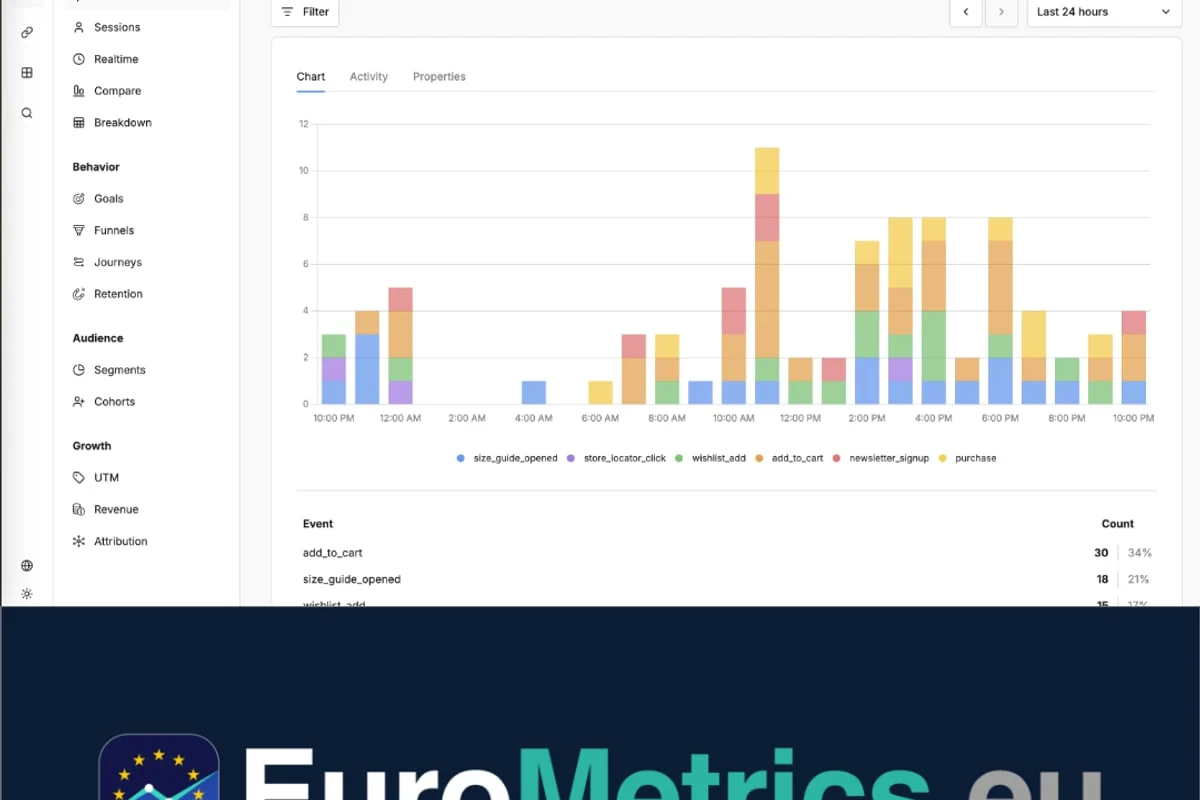
Modern European businesses need analytics solutions that respect digital sovereignty whilst delivering actionable insights. Platforms designed specifically for the European market understand these requirements from initial architecture through ongoing development. EuroMetrics offers a cookieless web analytics platform hosted entirely within EU data centres, providing full tracking without cookie consent banners.
Understanding Data Minimization Principles
The principle of data minimization requires collecting only information necessary for specific purposes. A well-designed website views tracker adheres to this standard by default, capturing essential metrics whilst avoiding excessive data harvesting.
Rather than recording every mouse movement and keystroke, minimalist analytics focus on meaningful interactions: which pages visitors view, how long they stay, where they arrive from, and where they navigate next. This subset of data provides sufficient insight for strategic decisions without privacy intrusion.
Advanced Features That Drive Business Value
Beyond basic visitor counting, sophisticated website views tracker platforms offer enhanced capabilities that transform raw data into strategic intelligence. Event tracking enables monitoring specific user actions like button clicks, form submissions, video plays, or downloads. These granular insights reveal how visitors interact with key website elements.
Conversion goal tracking connects analytics data to business outcomes. Define valuable actions (newsletter signups, product purchases, contact form completions) and measure how effectively your website drives these conversions. Attribution reporting shows which traffic sources generate the most valuable visitors.
Advanced analytical features:
- Campaign tracking with UTM parameters
- Custom event definitions for specific interactions
- Funnel analysis showing multi-step conversion paths
- Cohort analysis grouping visitors by acquisition date
- Segment filtering to analyze specific visitor subsets
Integration capabilities extend a website views tracker’s value by connecting analytics data with other business systems. Export functionality allows importing visitor metrics into spreadsheets, business intelligence tools, or customer relationship management platforms.
The ISO standards for web analytics provide frameworks for consistent, reliable measurement practices across organizations and industries.
Real-Time Versus Historical Analysis
Different business scenarios demand different temporal perspectives. Real-time dashboards show current visitor activity, valuable during product launches, marketing campaigns, or content releases. Watching visitor counts rise immediately after publishing new material provides instant feedback on promotional effectiveness.
Historical analysis reveals patterns invisible in moment-to-moment data. Monthly traffic trends, seasonal variations, and long-term growth trajectories emerge only when examining extended timeframes. A complete website views tracker supports both perspectives, enabling tactical and strategic decision-making.
Interpreting Your Analytics Data
Collecting data is merely the first step; extracting actionable insights determines analytics value. Begin by establishing baseline metrics for your website’s normal performance. Understanding typical daily visitor counts, average session duration, and standard bounce rates provides context for evaluating changes.
Look for patterns rather than fixating on individual data points. A single day’s traffic spike might result from a viral social media post, whilst sustained week-over-week growth indicates broader success. Similarly, temporary bounce rate increases during site maintenance differ fundamentally from persistent engagement declines.
Key interpretation principles:
- Compare equivalent time periods (Mondays to Mondays, not Mondays to Saturdays)
- Consider external factors (holidays, industry events, seasonal variations)
- Segment data by traffic source for clearer insights
- Track trends over multiple weeks or months
- Correlate metrics with specific actions or changes
Common misinterpretations plague website analytics. High visitor numbers don’t guarantee success if those visitors immediately leave without engaging. Similarly, low bounce rates mean nothing if visitors browse aimlessly without completing valuable actions.
Turning Insights Into Action
The ultimate purpose of any website views tracker is informing better decisions. When analytics reveal that blog posts generate more engaged visitors than product pages, consider expanding content marketing efforts. If mobile visitors show higher bounce rates than desktop users, prioritize responsive design improvements.
Create feedback loops connecting analytics insights to website modifications. Implement changes based on data observations, then monitor how those changes affect subsequent metrics. This iterative approach continuously improves website performance over time.
Tools like SEO audit platforms complement analytics by identifying technical improvements that boost organic traffic. Combined with visitor tracking, these resources cover both sides of optimization.

Balancing Multiple Analytics Platforms
Some businesses employ multiple tracking solutions simultaneously, whether for comparison, redundancy, or accessing different feature sets. This approach carries both advantages and complications.
Running parallel analytics systems confirms data accuracy through cross-validation. When two independent platforms report similar metrics, confidence in that data increases. Discrepancies prompt investigation into tracking implementation, bot filtering, or methodological differences.
However, multiple trackers increase page weight and potentially slow loading times. Each additional script makes websites marginally slower, degrading user experience and search engine rankings. Performance monitoring through speed testing helps quantify this impact.
Aspect | Single Tracker | Multiple Trackers |
|---|---|---|
Implementation effort | Low | Moderate to high |
Page load impact | Minimal | Cumulative |
Data consistency | N/A | Requires reconciliation |
Feature access | Limited to one platform | Best of all platforms |
Cost | Lower | Higher |
The practical recommendation for most European SMBs is selecting one complete website views tracker that meets all requirements rather than layering multiple partial solutions.
Future Trends in Website Analytics
The analytics market continues evolving rapidly. Cookieless tracking will become standard rather than exceptional as third-party cookies face complete elimination across all major browsers by 2027. Website views tracker platforms already embracing this shift position their users advantageously.
Server-side analytics grows in prominence, processing visitor data on web servers before transmission to analytics platforms. This architectural approach offers improved accuracy by bypassing ad blockers and providing greater control over data handling.
Artificial intelligence increasingly augments human analysis. Machine learning algorithms identify anomalies, predict trends, and suggest optimizations automatically. However, these capabilities work best when built on privacy-respecting foundations rather than invasive tracking.
Privacy regulations will likely tighten further rather than relax. European businesses adopting privacy-first analytics now future-proof their operations against increasingly stringent requirements.
Frequently Asked Questions
What’s the difference between page views and unique visitors?
Page views count every page load regardless of who views it, whilst unique visitors represent individual people visiting your site. One unique visitor might generate multiple page views during a single session. Unique visitor counting typically uses cookies or cookieless identifiers to recognize returning users within a defined timeframe, usually 24 hours or 30 days.
Can a website views tracker work without cookies?
Yes, modern analytics platforms successfully track visitors without cookies through several methods. Server-side analytics process visitor data using anonymized IP addresses, user agent strings, and session-based identifiers. These techniques provide accurate traffic metrics whilst eliminating cookie consent requirements, creating better user experiences without compromising data quality.
How does data hosting location affect my analytics?
Data hosting location affects three key factors: regulatory compliance, data access speed, and legal jurisdiction. Analytics data stored in European data centres remains under EU law, simplifying GDPR obligations and avoiding complex data transfer mechanisms. Geographic proximity also reduces latency, providing faster dashboard loading times for European users.
What metrics matter most for small businesses?
Small businesses should prioritize traffic sources, conversion rates, and engagement metrics over vanity metrics like total page views. Understanding which channels drive qualified visitors, measuring how effectively your website converts visitors into customers, and tracking which content resonates most with your audience delivers actionable insights that directly impact revenue.
How often should I check my website analytics?
Checking frequency depends on your business model and website activity level. E-commerce sites benefit from daily monitoring to catch issues quickly, whilst content publishers might review analytics weekly. Regardless of review frequency, establish regular reporting rhythms rather than checking sporadically. Monthly performance reviews help identify trends invisible in daily fluctuations.
Do analytics tools slow down my website?
Analytics scripts do affect page loading speed, though the impact varies significantly between platforms. Lightweight, asynchronous tracking code causes minimal performance degradation, whilst heavy scripts with extensive features can noticeably slow page rendering. Choose platforms that prioritize performance and test your website speed regularly to quantify any impact.
Understanding visitor behaviour through reliable tracking transforms how European businesses approach their digital presence. Selecting a website views tracker that balances detailed insights with respect for privacy ensures sustainable analytics that build rather than erode customer trust. EuroMetrics provides cookieless analytics hosted entirely within European data centres, delivering the metrics you need without cookie consent banners or privacy compromises. Start tracking your website with confidence in data sovereignty and visitor privacy.